
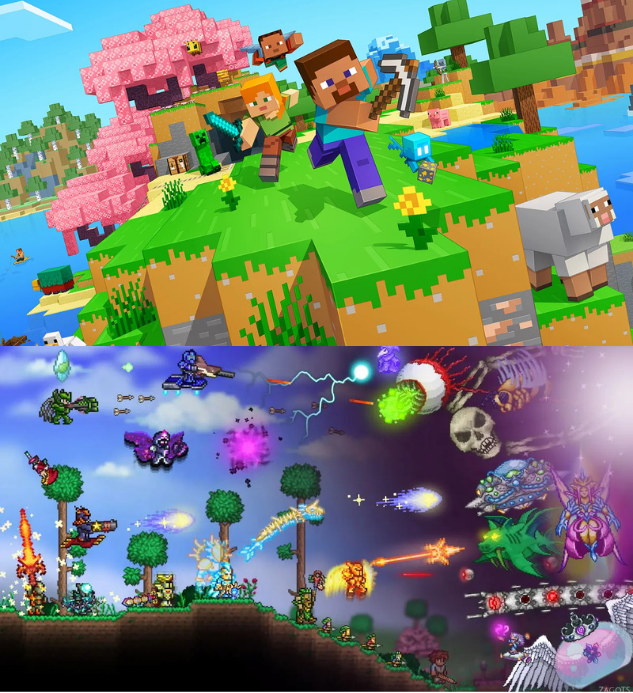
Whenever someone mentions the game Terraria, it’s impossible to escape the phrase “2D Minecraft”. As an avid player of both games, this has long frustrated me. Of course, both games clearly share the same genre, as both are block-based sandbox RPGs. However, the similarities (mostly) end there. Given that, is Terraria really a 2D version of Minecraft? How do the games compare in their similarities? And, which one makes a better sandbox game in 2026?
First off, a little bit of an introduction. Minecraft was released in 2009, started by a single person: Marcus “Notch” Persson. A small team then continued to work on the game, gathering a loyal following and a large amount of popularity. The online community was thriving, and people loved it. The team then sold Minecraft to Microsoft in 2014 for over $2 billion. Since then, the game has gone through many phases of popularity, yet Microsoft mostly refuses to do anything with the game. Despite this, Minecraft remains an icon of gaming, if a little bit old, in 2026.
Terraria was released to the world in 2011 by an indie studio called ReLogic. ReLogic was created to develop Terraria and collaborate with other indie studios, and is headed by Andrew “Redigit” Spinks. Currently, it has eleven core members who continue to work on Terraria to this day. Terraria’s community, while smaller, is thriving as well, complete with large internet presences and complex community made modifications for the game which are regularly updated.
So, how exactly are Terraria and Minecraft similar? I have played both of these games since my childhood. Since then, I have easily surpassed over 1,000 hours (if not more) on both, so I think I might be even a little bit overqualified in discussing this topic. Both games are sandbox RPGs. That is, players in both games have the freedom to do basically whatever they want, but the primary goal is to adventure around a hostile world to gather resources and items.
Minecraft is a fantasy sandbox RPG, where the player moves around a 3D world and can build and morph the terrain however they want. The core game is pretty simple, with few controls, a simple crafting system, and set progression. However, the player will eventually traverse through dimensions to find and craft enchanted swords, armor, potions, an elytra (glider) and other magic items. Throughout the game, the player is given plenty of freedom to build and explore as they like, and the simplicity is largely preserved.
Terraria, while similar in broad concept, is a lot less limited in scope. Like Minecraft, the player starts with nothing and has to explore a vast world for resources. Unlike Minecraft, Terraria focuses a lot more on combat and treasure gathering than Minecraft’s, well, mining.
Also, while Minecraft faithfully sticks to their fantasy theme, Terraria explores a lot more ideas. Players might find themselves fighting magic-wielding skeletons in the dungeon, peacefully building homes and towns for friendly NPCs, and defending their world from a Martian invasion or Lovecraftian horrors in a matter of minutes. I often find that this is one of the major advantages that Terraria has over Minecraft. The fantastical and insane nature of the game makes the developers unafraid to add whatever they want, as long as it’s cool and interesting.
Speaking on advantages and disadvantages, let’s discuss which game makes a better sandbox game in 2026. Since that topic is difficult to approach head on, I divided the “RPG Sandbox” genre into a few distinct categories, those being exploration (1), building (2), progression (3), combat (4), and multiplayer (5). In each category, I discussed the similarities and differences between the games (related to the category), and ultimately decided on a winner. Also, feel free to disagree with my ideas, as this is ultimately an opinion piece.
1. Exploration
Exploration is clearly an important element in both Terraria and Minecraft. They both involve expansive, randomly generated worlds, yet the way those worlds function facilitate the player’s exploration differs significantly. First and foremost, worlds in Minecraft are (functionally) infinite. The player can run, fly, or swim in one direction for hundreds of hours and never reach the edge of the world. However, in order to achieve this effect, Minecraft worlds are very repetitive.
There are never any unique features, only a few interesting structures or features copied and pasted across the landscape. The dozen or so biomes also don’t differ all too much, only really changing how the world looks. However, in Minecraft, going exploring feels more like going on a long adventure, as the world keeps going as the player travels. In order to explore successfully, players have to adequately prepare resources and plan out the exploration beforehand due to the scale of the worlds.
On the other hand, Terraria worlds are one hundred percent finite. They had a designated left edge, right edge, top edge, and bottom edge. However, that is not to say these worlds are small. In fact, it is incredibly difficult to explore a small fraction of the world, even more so to discover every biome. However, as the player’s power expands, and they gain the ability to run, fly, and teleport, the world feels like it is shrinking, and the feeling of mystery and discovery fades as each playthrough drags on. This does actually have some advantages, though. Terraria is a difficult game (much more so than Minecraft), and players do die quite often. Therefore, it would get frustrating if the player had to travel for several minutes to return to a challenge multiple times.
Also, the biomes and features in Terraria all feel completely different. They look different, have different music and ambience, have different enemies and challenges, different bosses, and they all have unique reasons to visit. The structures and features in Terraria also just feel more rewarding to discover. Repeating features such as the sky islands and underground cabins have important items that will fundamentally impact the way you play the game, and important one-of-a-kind structures such as the Dungeon and the Jungle Temple will change as the player progresses through the world. The world is always changing, and every major progression step allows the player to rediscover new items and features in the biomes they already explored.
Therefore, while Minecraft has infinitely generating worlds, Terraria wins the exploration point. Minecraft’s worlds are amazing and huge. Terraria worlds, while clearly smaller, feel alive and ever changing as new biomes grow, spread, morph, and die.
2. Building
Building in both Minecraft and Terraria feel very different, and often serve completely different purposes. Of course, both games allow the player to build practically whatever they want. With a world neatly divided into a grid of blocks, building is intuitive and simple. Yet the depth, purpose, and ceiling of these games are quite different. However, players in both games build for many different reasons.
First, let me discuss aesthetic building. Neither Minecraft or Terraria encourage players to build anything aesthetic. Therefore, if a player does build something just because it looks cool, and serves little actual purpose, it’s because they want to express their creativity. Minecraft is a 3D game. Therefore, it has an immediate leg up in the building aspect. With an extra dimension to play around in, you can be a little bit more creative. Also, since Minecraft is from a first person perspective, you can visually see more of the world.
Therefore, if you spend hours building a massive structure, it is much more satisfying since you can actually see the entire thing without entering a special camera mode. Since Terraria is 2D, and the camera is a fixed 3rd person perspective, it is very difficult to see an entire build at once.
Instead of building for aesthetics, players in both games often focus on building for a purpose. As someone who just looks up tutorials for most of the automatic farms I build, I don’t have too much experience on coming up with automation ideas or figuring out the puzzle of developing such a build. I do know, however, that the automatic farm scene is a lot more present in Minecraft than it is in Terraria. This could be a result of resource gathering being more tedious in Minecraft, or it could be because automatic farms are a lot more conventional in Minecraft. Therefore, aside from aesthetic building, most of the building done in Minecraft is for automation and efficiency.
On the other hand, most of the building done in Terraria is for one thing: bossfight arenas. I won’t go too much in depth into the bosses until the combat section, but you do need to know that most bosses need to be fought in a specific biome or area, and each one has a unique gimmick. For example, Skeletron must be summoned at the Dungeon and fought at night, Plantera can only be summoned in the underground jungle and will become engraved if it leaves the underground jungle, and the Wall of Flesh can only be summoned in the underworld and constantly moves across the world in one direction. Therefore, good bossfight arenas will need to cater to the boss the player wants to defeat, and thus, they all might look completely different.
Staying with the existing examples, an arena to fight Skeletron might be at the entrance to the Dungeon and have platforms that the player can grapple to to avoid his charge attack; an arena for Plantera could be in the underground jungle and have a pit at the bottom to trap all of the bouncing spike projectiles; and an arena for the Wall of Flesh could be a long platform in the underworld to run in one direction as the boss sweeps across the bottom of the world. Thus, the player can get an advantage in different bossfights if they are creative with the arenas they build.
However, while Terraria does offer some unique reasons to build, the extra dimension in Minecraft offers too much opportunity for creativity. The ingenious designs of resource farms and the scale of megabases in Minecraft are absolutely insane, and therefore Minecraft deserves the building point.
3. Progression
Both Terraria and Minecraft are “Sandbox RPGs”. The “RPG” element comes from the progression and scaling as the player levels up and progresses through the game. There are generally very few similarities between these two games in terms of progression, so I’ll just jump right to the differences.
In Minecraft, players find themselves crafting tools and armor with ores and resources they find by mining underground. Eventually, players will use their resources to enchant their tools with magic powers and find other magic items that allow easy traversal and domination of the world, such as the Elytra, Totem of Undying, and Wind Charge. Most of these items are either found or crafted, so in order to obtain these upgrades, the player must explore caves and other dimensions for ores and resources. Obtaining these items is pretty fun, and the abilities they unlock are definitely interesting.
However, the most important upgrades in Minecraft, the enchantments, are monotonous to obtain and unlock a few new abilities. Enchantments are upgrades that must be applied to each tool, piece of armor, and weapon. These enchantments do little more than simple stat boosts, and therefore, they don’t feel too exciting to use or obtain.
In order to enchant an item, the player must spend hours either trading with NPCs in a system that’s little more than a lottery, or rerolling enchantments on an enchanting table, another form of lottery. Therefore, in order to unlock some of the most powerful upgrades in the game, the player must mindlessly click through interfaces for hours on end.
Terraria upgrades are very different. First off, every single upgrade drastically changes how the game is played. This could be unlocking a new area, a completely unique attack, or a new movement ability. Therefore, each upgrade in Terraria feels satisfying and worth the effort. Speaking of the effort, upgrades in Terraria mostly come from two different sources: defeating a boss or by gathering resources and crafting. Both of these are fun to do. Gathering resources might feel a little bit grindy, but in doing so, you are also exploring and traversing the world. Fighting bosses is even more fun, and I will discuss that more in the next section.
In Terraria, the world also upgrades alongside the player. This keeps the game challenging and fresh when the player levels up in power. In contrast, Minecraft upgrades make the game feel easy and stale.
Therefore, I’m giving the progression point to Terraria. The sheer variety and number of upgrades offered to the player, alongside four completely different upgrade paths (given by the four different classes), offers so much content which is both fun to obtain and to use.
4. Combat
Combat is present in PvE (player versus enemy) forms in both Terraria and Minecraft. In the beginning of both games, they do feel quite similar. Players use melee weapons and primitive ranged weapons to knock enemies away and avoid contact damage. However, as the player progresses through each game, the combat starts to feel a little bit different.
Minecraft combat largely focuses on knockback, even later in the game. The weapon toolset is also strangely limited. Players still fight monsters with swords, axes, and shields, the exact same tools they had at the beginning of the game. Now, they just do a lot more damage. Minecraft does offer some unique combat items, like tridents, spears, maces, potions, and more. However, the monsters in the game don’t offer enough of a threat to force the player to deviate from the sword and axe.
In stark contrast, Terraria combat changes a lot throughout the game. In fact, it offers four entirely different playstyles that are completely populated with upgrades and items. Each of these “classes” has an entirely unique combat style, strengths, weaknesses, and upgrade path. As the player progresses along their upgrade path, they will encounter new items that change how combat works.
Unlike Minecraft, the enemies the player encounters will progressively increase in difficulty, matching the player and providing a challenge every step of the way.
In Minecraft, the primary method of avoiding damage is by knocking enemies away. In Terraria, the player uses a wide variety of movement abilities to dodge attacks and enemies. These include rocket boots, wings, rideable mounts, minecarts, unique movement abilities, and much more. This leads into the primary advantage of Terraria in this section: bosses.
Terraria bosses are so much fun. Each boss has a unique way to summon it in, unique attacks, unique animations, unique music tracks, and unique rewards or “drops”. Boss attacks take advantage of the fact that players have such powerful movement abilities, and thus test how much control the player has over their movement. Dodging and weaving through attacks is one of the most satisfying (and intense) things to do in the game, as each mistake takes a huge chunk out of your health bar. Each fight is a mechanical challenge or “skill check” that promises progression and powerful upgrades if you succeed. Therefore, bossfights in Terraria serve as fun challenges that facilitate the player’s progression.
Unfortunately, Minecraft really struggles in the bossfight department. The game’s bosses are really quite simple, and due to the player’s limited ways to avoid damage, boss attacks never test the player’s skills.
Therefore, the combat point is given to Terraria for having some of the most fun fights (and some of the best combat mechanics) out of any game I have played.
5. Multiplayer
I think it’s safe to say that both Terraria and Minecraft are supposed to be played with friends. They both have support for cooperative and competitive, but in very different forms. First, cooperative multiplayer (or co-op) in both games is amazing. Support is awesome, with Terraria taking advantage of the Steam multiplayer support. Minecraft used to be slightly behind, but Mojang recently released an update that allows multiplayer without buying server resources.
Both Minecraft and Terraria struggle with cross-platform multiplayer (such as a console playing with a PC, etc). In terms of actual game mechanics, they both function very well as cooperative multiplayer. In Terraria, multiple different classes allow each player to contribute in different ways at the same time. In Minecraft, different elements of progression can be done by different players. Therefore, they both are basically the best they can be in the cooperative multiplayer aspect.
However, when considering competitive multiplayer, one game clearly pulls ahead. Terraria competitive multiplayer support is very limited. Terraria’s game mechanics are almost impossible to balance in competitive multiplayer. Consequently, player versus player (PvP) combat is incredibly unpredictable and inherently unfair. Also, beyond simply allowing players to damage each other with weapons, there really is very little in terms of competitive mechanics.
In contrast, Minecraft competitive multiplayer is amazing. Servers are online 24/7, making a sort of race to set up a base of operations and gather tools and resources. This is enhanced by the fact that progression is done mostly independently. The PvP in Minecraft is also simple enough so that it is fun to express skill in combat. Finally, upon dying in Minecraft, players will lose all of their items and upgrades. This makes it very rewarding to win a fight and punishing to lose a fight. It also enhances the “base building” aspect of the game. If someone builds a better, more efficient base, they can gather new upgrades and items faster to recover after a loss.
Therefore, Minecraft takes the multiplayer point for having great competitive game mechanics.
Conclusion
Wow, that was a journey. Now, which one makes a better sandbox game in 2026? If we tally up the points in the abstract categories I invented, Terraria wins 3-2. In all seriousness, both Minecraft and Terraria are works of art. They pretty much offer infinite content and infinite playtime for every demographic. For people who want a chill building game, they both offer that. For people who want a sweaty, difficult experience, they offer that too.
So, is Terraria a 2D version of Minecraft? I would say of course not. While sharing the same genres, they are ultimately two different, distinct games.
If you haven’t already, I highly encourage you to give both games a fair chance. Terraria is $9.99 on Steam, and you can play on pretty much every console and PC. Minecraft Java is $29.99 on PC, and Minecraft Bedrock is also $29.99 on most consoles. If you have already played both games, feel free to disagree with my opinions. Thanks for reading!




Jonah Iwankow • Jun 3, 2026 at 11:35 pm
treasure vs treasure