

After eight long years, the Australian game studio Team Cherry released the sequel to their award winning metroidvania Hollow Knight. A metroidvania is a style of game where you gain power ups to progress through the world, named after the two pioneers of the genre Super Metroid and Castlevania. The sequel to Hollow Knight was the number one wishlisted game on the online store, Steam, quickly after its announcement. On the first day of its release, September 4th, 2025, the amount of transactions taken place caused major crashes in the Nintendo eShop, Steam servers, and Xbox store. It immediately overcame the all time player count of its predecessor by 491,495 live players on day one.
But was Hollow Knight: Silksong worth the wait?
First, there needs to be some background.
Introducing Team Cherry: a two person studio based in Adelaide, Australia and founded by Ari Gibson, artist and animator, and William Pellen, game designer. Together, they began a couple of small scale projects, releasing Tomb Cat and Hungry Knight on the website Itch.io. They were not met with much praise, but allowed the two amateur developers to learn how to, well, develop games. Using the inspiration from their game Hungry Knight they began their first large scale project.
They followed the design philosophy that they should keep adding elements to their game until they ran out of money (which happened frequently), when they would then use kickstarters to raise more. They continued this cycle until they believed to have a finished product, and released Hollow Knight on February 4, 2017. With frequent content updates and high quality levels, the game rose in popularity steadily, acquiring a modest fanbase by the time the last free DLC was released.
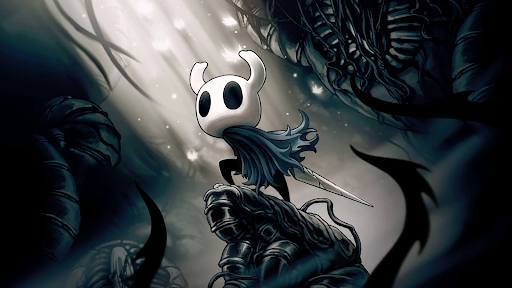
In 2019, the team announced they were working on a sequel to their game. Originally being planned as another free DLC, this sequel would star a side character from Hollow Knight, Hornet. Only, instead of constantly releasing progress updates, Team Cherry went MIA. They published minimal statements for many years.
That was, until August 21st, 2025, when a release date trailer was announced. The game would drop on the 4th of September. After a long wait, this sudden release was surprising to many people, as was the small sticker price of $20.00 in a medium where large scale games can creep up to $80.00.
Hollow Knight: Silksong begins with a short, hand drawn cutscene and immediately drops the player into the game. No long cinematic intro, no boring tutorial, and no bloated main menu screen littered with microtransactions. The gameplay itself begins quite simply, with only basic combat and a heal move. However, as you progress through the world, you gain abilities that are very useful and sometimes mandatory for progression, which is a staple for the metroidvania genre.
The following review will contain spoilers for the first of three acts contained in the game.
PROS
The things I believe that are done superbly are expansive, but I will attempt to summarize them here.
Firstly, the combat presented in Silksong is a fresh twist on that of Hollow Knight. It is quicker and more deadly, with each decision resulting in a swift victory or end. There is also much larger customization available within, allowing for each player to find a playstyle that suits them, due to the addition of different weapons and power ups. To me, I found a resemblance between Team Cherry’s Silksong and Hollow Knight versus Fromsoftware’s Bloodborne (2015) and their Dark Souls (2011). Both predecessors were the stepping stones towards a true magnum opus, evolving careful, slow paced, and defensive gameplay style into a difficult and razor fast one. The main character, Hornet, also has many more tricks and tools up her sleeve than The Knight did in Hollow Knight.
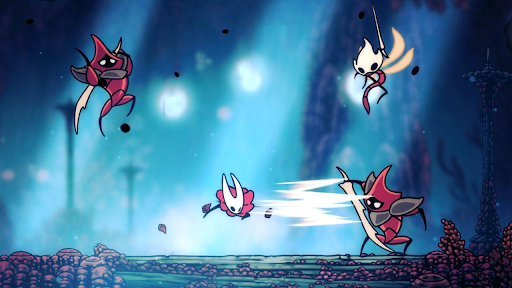
The second huge selling point of me was the world. I was concerned that the kingdom of Pharloom from Silksong would feel too similar to the kingdom of Hallownest from Hollow Knight. From the snippets we got from trailers, they contained some of the same stereotypical areas, from lush green forests to barren grey caves.
However, upon exploring the vast expanse that was laid out, it seems apparent that Team Cherry outdid themselves. The kingdom seems so expansive, that every time you make your way through it you find something new. Each area contains so many different secrets and unique parts to it, and it truly rewards curious players. Hidden in every nook and cranny could be an interesting NPC, a powerful upgrade, a secret collectable, or some interesting lore tidbit that gives the game just so much more life.
One huge detail for me that usually goes unnoticed is the musical score. The composer of the soundtrack, Christopher Larken, also worked on Hollow Knight’s sound design. And oh boy, did he knock it out of the park with this one. Each track feels completely different, with so much character and personality within. Larken can have you focused, scared, and crying within the contained music.
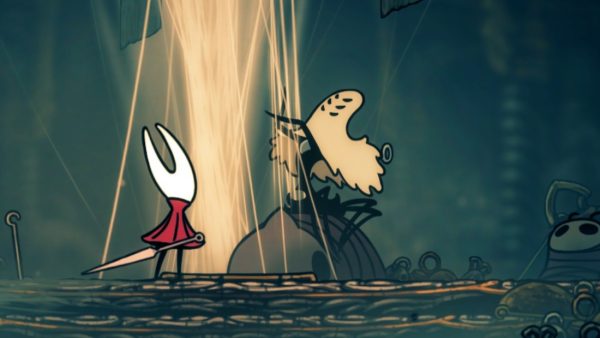
Another point that I don’t feel is conversed on enough is the story. While I’m not usually interested in the lore of my video games very much, this one had me drawn in completely. There is plenty of environmental storytelling, amazing characters, and lots of thought out narrative, instead of some simple goal to drive the game forward.
One heavily debated topic that was at the forefront of the discussion was the difficulty in the game. Some newer players found the challenge too daunting, while others felt it too easy. For me in particular, it perfectly scratched the itch that I got from Hollow Knight.
It truly feels like Silksong is a sequel in the most traditional sense, as it expects you to bring over all of the skills you worked so hard to develop. Silksong’s approach to difficulty comes not from gimmicky and unfair situations, but from punishing yet fair boss enemies that feel like they are trying their hardest to give Hornet a fair duel.
CONS
Now, onto the admittedly sour notes of Silksong’s release.
Although I personally loved the approach to difficulty, there were some sections in the game where the distance between a tough boss enemy and the nearest checkpoint was quite long (I’m looking at you, Bilewater!). That specifically was one aspect I did not enjoy, however fun the bosses may end up being.
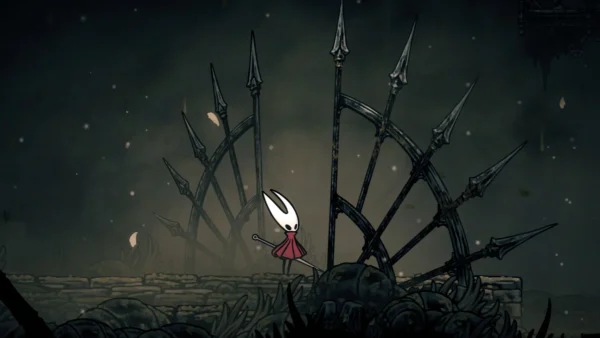
Additionally, the introduction of a quest mechanic was a choice, but the exact implementation felt a little off. Although some of the quests were very interesting and involved tracking prey or completing difficult tasks or bosses, some were lacking and seemed to be glorified fetch quests or ‘kill x amount of each enemy.’ However, these are entirely optional unless you want to access the post – game act 3.
All in all, I think the positives definitely outweigh the negatives, with plenty of world to explore and all that you can do within it. To me, Hollow Knight: Silksong is a very refreshing game in a genre where there is a lot of stagnation. You can tell the development team really put their hearts into this game in effort to draw you in and make it feel alive. It seems like Team Cherry really was just having fun while developing Silksong, and I truly recommend this game and its predecessor to those looking for a genuine and quality experience for a very small and manageable price.
In summary, all these topics and benefits, at least for me, prove that Hollow Knight: Silksong was truly worth the wait.


Jonah Iwankow • Nov 7, 2025 at 8:42 am
SHAW!!!!