A blinding lens flare, a vault door rolling slowly open, and a hand reached out to block the sun. This is a sight welcomed by all those familiar with the bleak world of Fallout. The true weight of this moment, which finally occurs after more than an hour of anticipation, would be lost on someone unfamiliar with the lore and world of the already famous video games. For a screen adaptation such as this, that can be lethal. However for Fallout these moments give it life, acting as a cherry on top of what is already a Nebula-worthy piece of retrofuturism.
If all an adaptation has to offer is a handful of niche references and callbacks, then an audience ignorant to its source material is left confused, bored, and disinterested. Fallout contains more references to its original property than any other adaptation in recent memory, yet despite this fact it rarely, if even, falls into the trap of isolating its new audience.
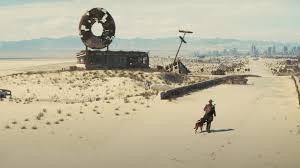
Fallout is not only a masterclass in adaptation, but a groundbreaking dystopian social commentary. It takes an already complex and long running continuity and exposes it to a new audience. It is able to remain fiercely loyal to its pre-established world while maintaining an incredibly high standard of quality that manages to be thoroughly enjoyable without prior knowledge.
The reality of Fallout is a macabre one. Since the release of the original video game on October 10th, 1997, the franchise has had a very morbid sense of humor and a cynical outlook on the world. Chronicling the world after global nuclear annihilation, often through the eyes of naive vault dwellers, the surviving population is a far cry from the capitalist nightmare represented in its pre-war plotlines.
The one constant, unifying thread present in all of its installments (aside from the fan favorite K9 companion Dog Meat) is the monstrous megacorporation, Vault-Tec. Ostensibly for the good of humanity, they are responsible for installing over 100 underground, radiation proof bunkers across the United States. Puppeted by an unknown CEO and directed by a morally bankrupt board of executives, Vault-Tec, as we learn, has much to gain from the end of the world.
Set in a universe where cultural progression (aside from civil rights developments) froze during the 1950s in favor of rapid technological advancement, Fallout exists as a unique mix of analog technology and modern sci-fi ideas. Specifically, problems with fusion technology had been significantly, although not completely, solved. The resulting fusion cores allowed for personal robots, vehicles, and the iconic power armor.
However, despite these developments, an energy crisis still threatened world peace leading to a global conflict. This conflict, known in universe as the Great War, appeared to result in the exchange of nuclear warheads between the United States and China on October 23rd, 2077. At least, that’s what we’ve been led to believe.
It is within the aforementioned nuclear vaults that humanity was able to survive the resulting fallout. And from those vaults the events of our show, and the conspiracy surrounding it, unfold.
Lucy, our main character, resides in vault 33, one vault in an underground complex containing the antecedent vaults 31 and 32. This seemingly peaceful, if not alarmingly peculiar, society is thrown into chaos when a group of violent surface dwellers, disguised as their isolated neighbors, vault 32, invade and assault the members of 33. This group of raiders, led by a mysterious woman named Muldaver, leaves not just with blood on their hands, but with a single hostage. Hank MacLean, Lucy’s father and overseer of vault 33, is taken to the surface for unknown reasons, leading an ever ambitious and idealistic Lucy to pursue her father despite the countless and unknown dangers that await her in the wasteland. It is this love for her father that takes us to that fateful moment: A blinding lens flare, a vault door grinding slowly open, and a hand reached out to block the sun.
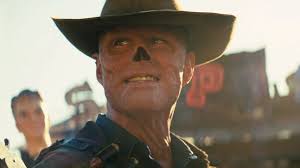
Shortly after her introductory day as a surface dweller, Lucy meets The Ghoul, Portrayed by the phenomenal Walton Goggins. The Ghoul isn’t just a name, it’s a creature. Someone who has been exposed to such intense amounts of radiation that rather than dying, they become immortal, disfigured monsters condemned to grow feral without regular administration of nameless yellow vials. It is this “gift” of immortality that allows The Ghoul to bridge the pre-war and post-war story threads.
After we’ve come to realize that The Ghoul lived before the bombs dropped, his motivation is slowly revealed through a riveting story set in the months before the Great War. By the final episode we finally understand why The Ghoul has been wandering the wasteland for over 200 years. And, just as we come to understand why The Ghoul does what he does, we realize that like Lucy, we understand nothing.
At the helm of such a passionate adaptation you can typically find passionate fans. Fallout is no exception. Developed by proud enthusiast Johnathan Nolan and written primarily by Graham Wagner and Geneva Robertson-Dworet, their familiarity with the property is apparent, dripping from every page of their script. Furthermore, this passion extended to all aspects of the show’s production.
Filmed primarily in Nevada, New York, and Utah, the show uses a gorgeous mix of practical and digital effects that add an undeniable tangibility to the larger than life events unfolding on screen. The Ghouls makeup is a prime example of this. Rather than opting for an expensive CG creation, the VFX team instead decided to accomplish the bulk of Goggins’ look with makeup, touching up and enhancing his decaying body in post production. Even more so, the advanced exosuits known as power armor were practically constructed and used on set, lending to its intimidation and aiding the already convincing performances.
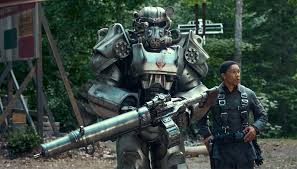
The exemplary cast, which consists of Ella Purnell, Kyle MacLachlan, the dark horse Aaron Moten, and the show stealing Walton Goggins, meshes together with incredible tension and chemistry. No one falls short, but some performances stand out as being especially captivating. Specifically, Aaron Moten and Walton Goggins are able to perfectly embody their characters and the in-game archetypes they parallel. Moten, who plays Maximus, a recruit in the paramilitary organization the Brotherhood of Steel, acts as a third companion and love interest to Lucy. The Brotherhood, whose goal is to secure and preserve important pre-war technology, is highly interested in Lucy, who has come into the possession of a highly sought after chip. This chip, which brings any and all factions in the wasteland to bear down on her, plays a crucial role in the quest for Lucy’s father.
Fallout is an incredibly complex show with numerous character arcs, plotlines, and references. Having such a dense tome of pre-established lore makes for a monstrous challenge. If it weren’t for the fans behind the cameras it likely would have fallen incredibly short, as is common in the world of video game adaptations. The beauty of Fallout is that rather than adapting a previously told story, they instead chose to tell an original tale in an adapted world that is cohesive with the video games. Furthermore, rather than holding the hand of the audience the writers trust that we can comprehend the complexity of its world and narrative without mountains of expository dialogue.
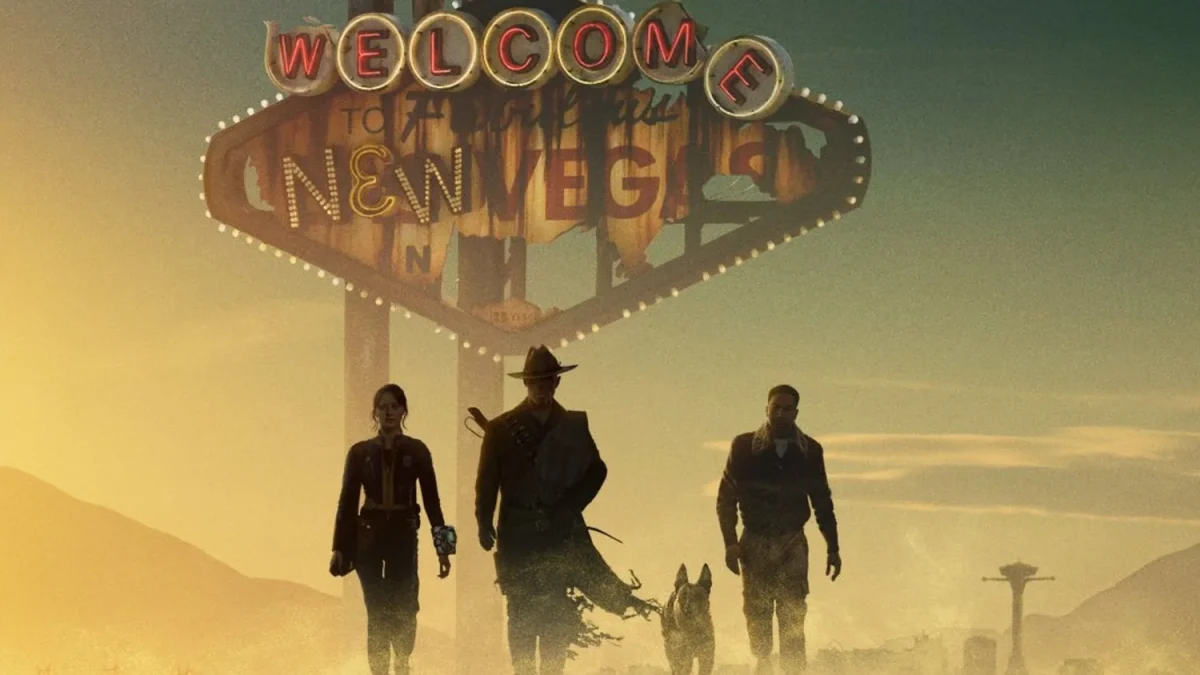
Fallout season one was released to immense praise on April 10th, 2024. Despite being based on a video game, which invalidates it in the eyes of elderly curmudgeons, it truly stands apart as a refreshingly original sci-fi epic, with some of the most well written characters since True Detective season one, ten years earlier. Season two is expected on December 17th, 2025, and as we approach that day I can only recommend you strap on your pip boy, hop in your power armor, and play the games. Pro tip: start with New Vegas.